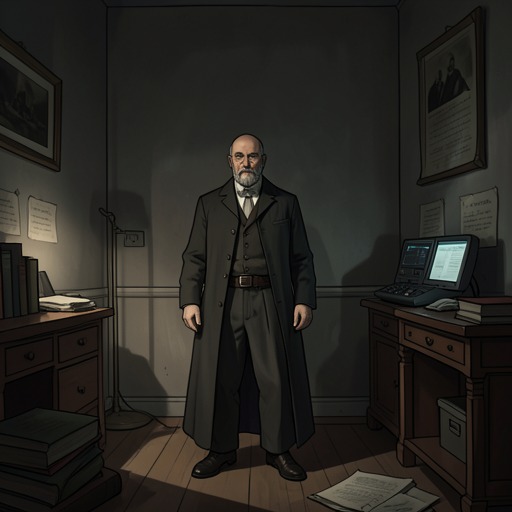
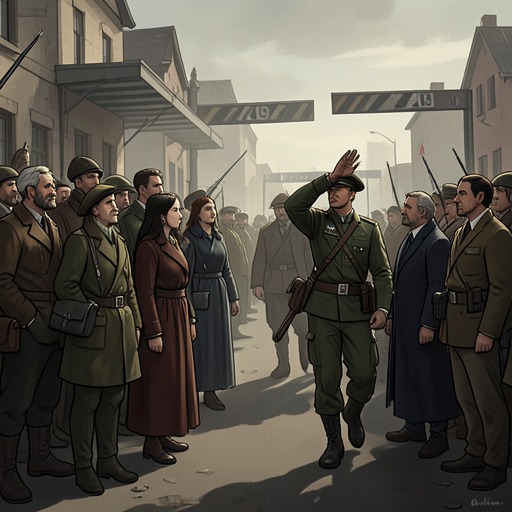
Oskar Hanák is arrested and sent to Terezín
The Glass RoomOskar Hanák’s arrest and reported deportation to Terezín become known not through a witnessed scene but through a letter carrying news already several steps removed. The uncertainty surrounding his fate exposes the violence of the persecution and the limits of what those who have fled can know or do: Oskar is said to have been sent where Jews are being gathered, while rumors about Hana point in conflicting directions.
The News and Its Uncertain Source
The report reaches the Landauers through a correspondent who has heard it fourth- or fifth-hand. Oskar, identified as Jewish, is said to have been arrested and sent to Terezín, where Jews are being gathered. The phrasing presents his deportation as credible news but not as firsthand testimony; the writer explicitly apologizes for being unable to be more precise. The distance between event and report is part of the event’s meaning: wartime communication transmits the fact of persecution while leaving individual fates unresolved.
The same letter cannot establish what happened to Hana. Some say she has been sent to Germany; others believe she went to Austria, to a work camp. The alternatives offer no reliable answer, only evidence that she too has disappeared into the machinery of persecution. Oskar’s reported destination is specific, but the couple’s shared fate is not.
The Marriage as a Newly Exposed Risk
Earlier, Hana states directly that her husband is Jewish. She makes the disclosure in response to a discussion of isolating Jews, looking her interlocutor in the eye; the fact is not abstract for her but bound to the person she has married. The later report of Oskar’s arrest gives that declaration its terrible consequence. What had been a private relationship now carries the danger of state persecution, and the news arrives with Hana’s own whereabouts uncertain.
The novel also situates the couple within a wider field of precarious lives. In the Glass Room, refugees are brought before an audience as three adults and three children: a family of four and a woman with her daughter, identified as Kata and Marika. Their crumpled clothes, the girl’s cracked spectacles, and the young child’s shabby floral dress make displacement visible, while the audience’s gaze turns their arrival into something like a performance. Oskar and Hana’s story belongs to this landscape of exposure and insecurity, but the letter’s rumor offers none of the refugees’ physical detail: it records what can be heard, not what can be verified.
A Letter From Exile
The report appears amid news of the Landauers’ own separation from home. The correspondent says the family tried to gain access to the house before leaving but was refused; the authorities possess it, though Laník says everything is all right. The former home has been used as a scientific laboratory and now stands empty. Against that dispossession, the uncertain news about Oskar and Hana makes return and reassurance seem still more fragile.
Elsewhere, Viktor searches offices and consulates for Katalin and her daughter after they were last seen in Bayonne, without knowing whether they remain in France or have reached Spain. Liesel comforts the children with lies. These parallel losses clarify the force of the Hanák report: families are separated, information arrives secondhand, and those left behind must live with possibilities that cannot be resolved. Oskar’s reported deportation is therefore both a concrete act of persecution and one fragment in a larger pattern of wartime disappearance.